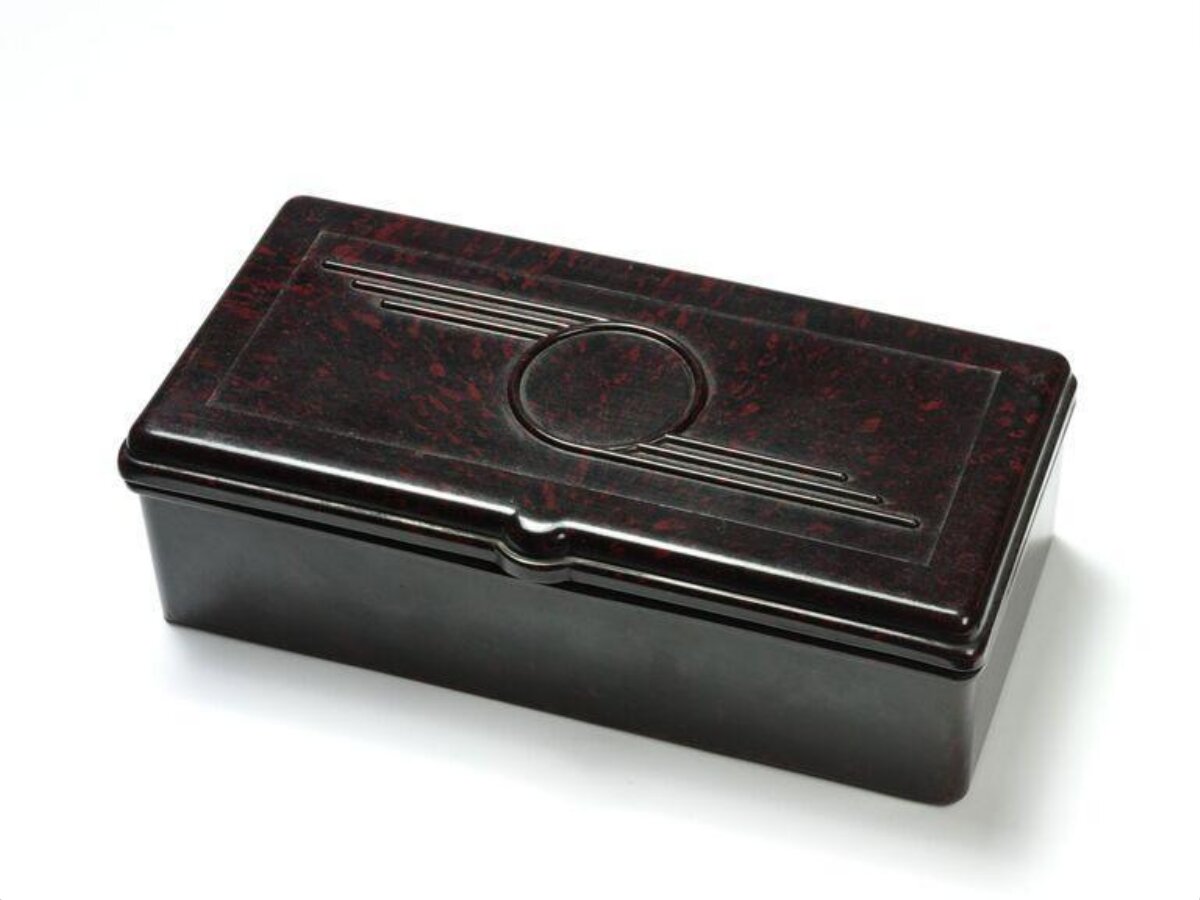
Cigarette box
Industrial use of plastics vastly increased during the 1930s. Plastic was perfectly suited to producing the sleek lines of Art Deco designs, and the geometric pattern on this box is similar to those used to decorate radios, commonly made of plastic. Bakelite was invented by Dr Leo Baekland in the USA before the First World War, as a synthetic material that lent itself to cheap mass-production moulding. The word was later used as a general term for early plastics. This box was probably used for cigarettes. After World War I social attitudes, probably encouraged by films, became more relaxed towards smoking, particularly among women, and it became a social habit for more than half the adult Br
Cigarette box · England · 1930-1940. Compression-moulded phenol formaldehyde ('Bakelite'). By Unknown. Victoria and Albert Museum, London.