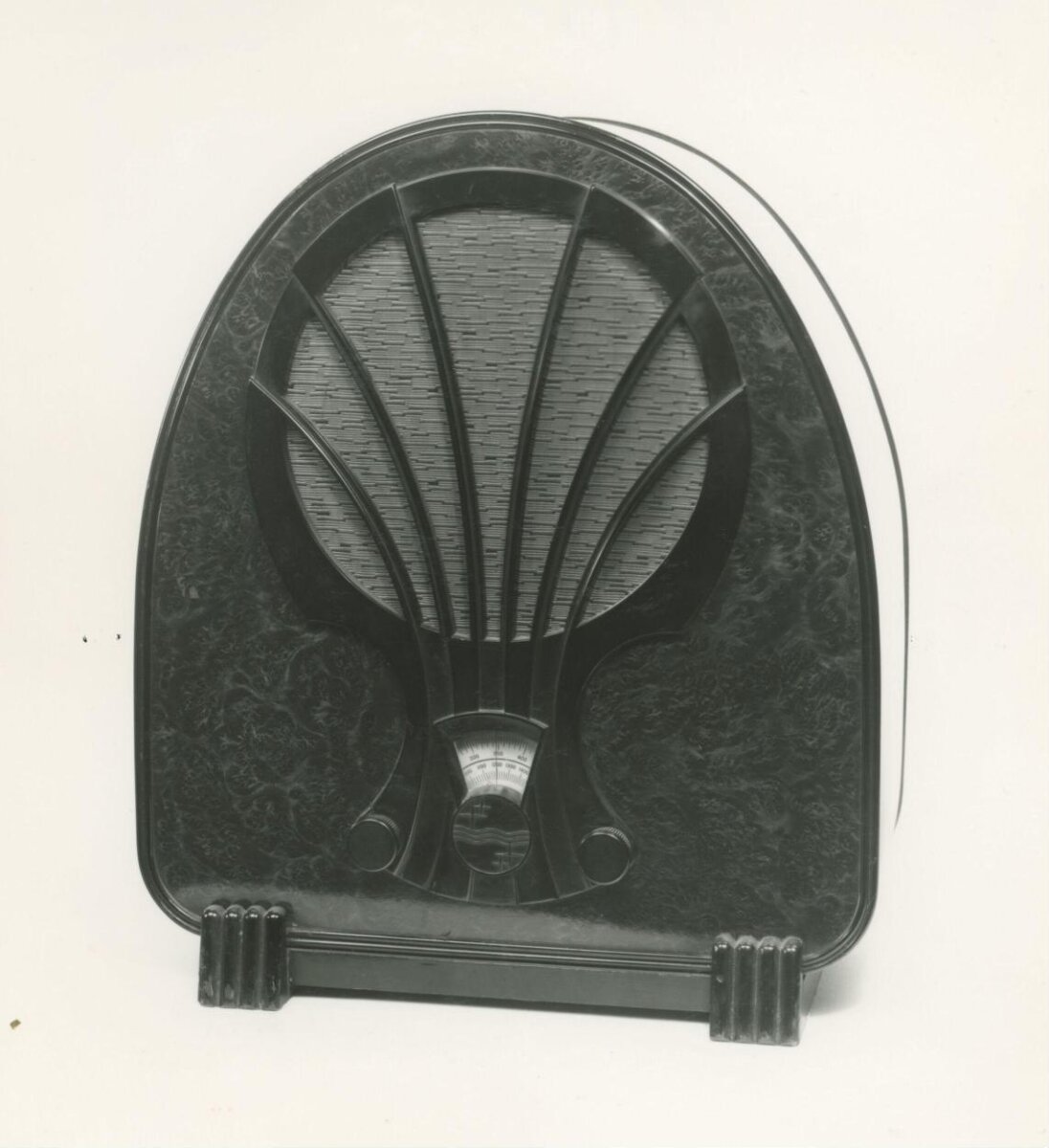
Philips model 834A
The Philips model 834A of 1933 was variously called in Dutch a 'knuckle of ham' or 'Easter' radio. In English it was referred to as a 'cathedral', a general name applied to all radio sets of vaguely gothic form. Philips were one of the earliest radio manufacturers to experiment seriously with plastics, though many others also took advantage of the expiry in 1927 of Leo Baekeland's original patent for Bakelite (a thermosetting plastic - phenol formaldehyde resin moulded under immense heat and pressure). This coincided with improvements in radio technology, while also serving to make the completed sets cheaper. Philips' version of Bakelite, Philite, was used to make the face of this set, while
Radio · Eindhoven · 1933. Laminated 'Arborlite' plastic; 'Philite' (Bakelite/Phenol formaldehyde). By Philips. Victoria and Albert Museum, London.