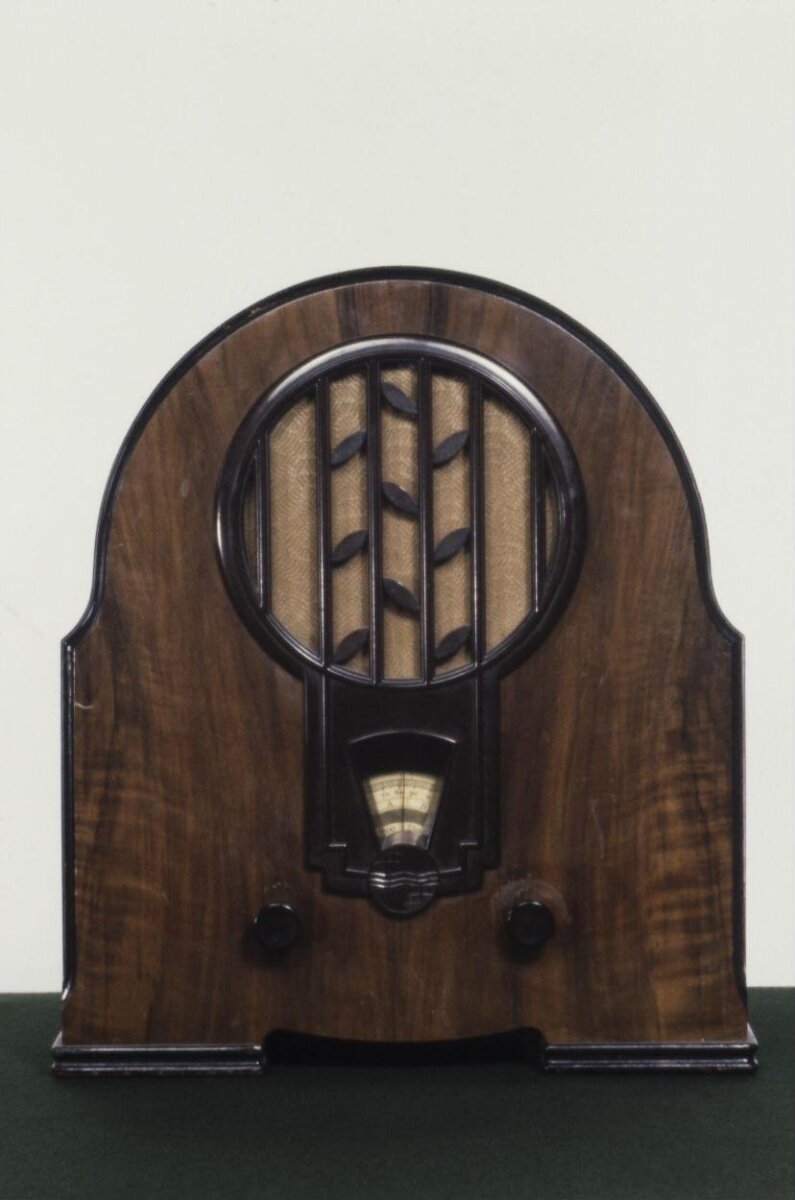
Philips Superinductance model 634A
This model is one of a series of receivers in which the Philips company achieved, with tuned radio-frequency circuits, a selectivity and range equal to that of contemporary superheterodyne receivers. The term ‘superinductance’ refers to the tuning coils, Litz-wound on glass formers whose efficiency was largely responsible for the success of the design. The receiver employs two variable-mu high-frequency amplifiers, preceded by a band-pass input circuit, and followed by a diode-tetrode detector/amplifier and a pentode output valve. The tuning knob controls four carefully aligned capacitors, and also a potentiometer which varies the bias on the high-frequency valves, to maintain constant sensi
Radio · Eindhoven · 1933-1934. Veneered wooden case; Bakelite. By Philips. Victoria and Albert Museum, London.