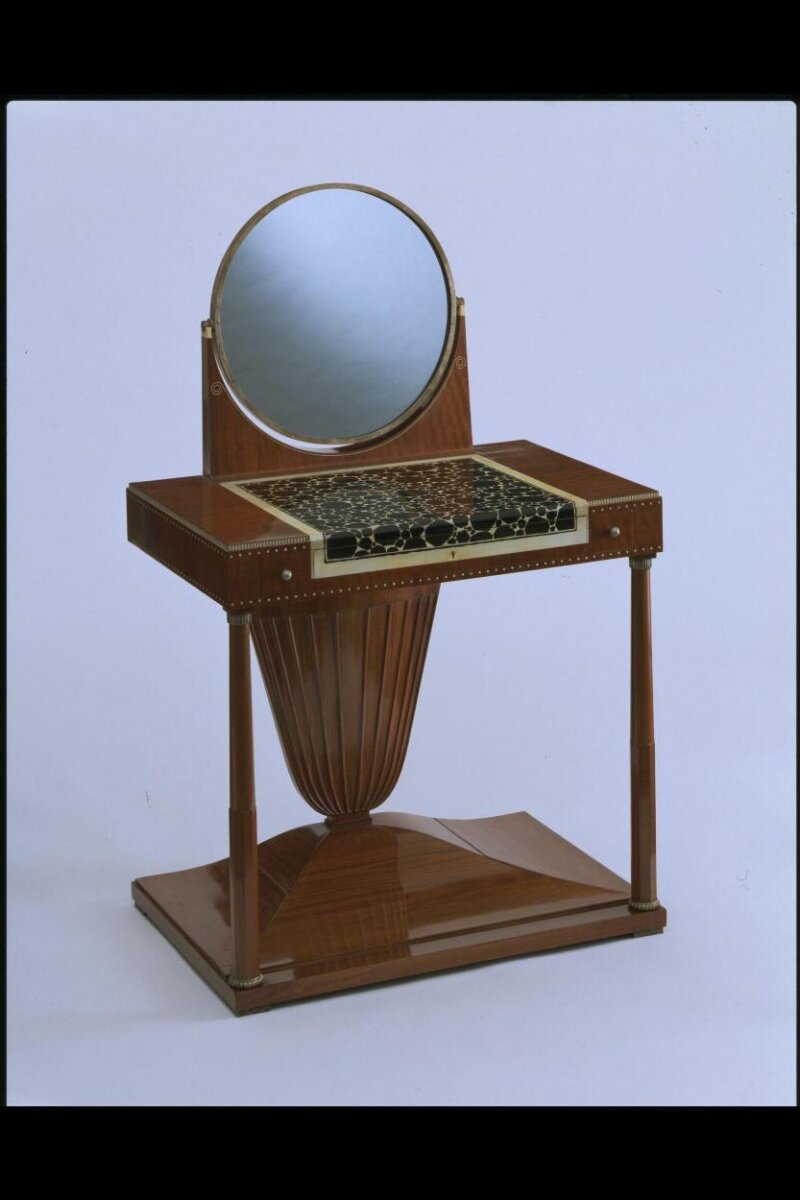
Dressing table
The form of this dressing table is loosely based on early 19th century examples. They too had a pivoting mirror attached to a table top. Here the contrasting ivory and ebony inlay of the top creates the illusion of a fine textile draped over the table. This is an amusing reference to the orgins of the first type of dressing table, called a toilette in French. The name came from the linen (toile in French) on which the mirror, brush and other objects sat. Ruhlmann often used this kind of illusionistic inlay in his designs. Other typical features of his work are rich materials and stylised surface decoration.
Dressing table · Paris · ca. 1919-1923. Oak carcase, veneered with Andaman padouk (on base and vase) and purpleheart (on top and mirror back), with solid purpleheart columns, inlaid with ivory and ebony, and mahogany drawers, and silvered bronze mirror frame and fittings. By Ruhlmann, Emile Jacques. Victoria and Albert Museum, London.