De Stijl
The Movement
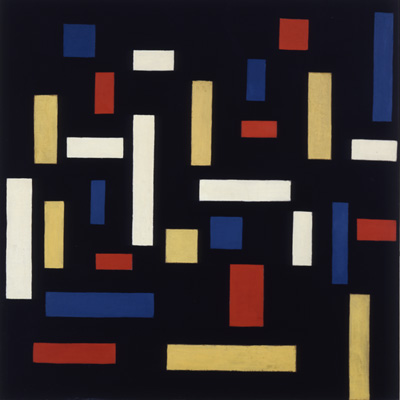
A Dutch philosophical commitment more than an aesthetic school. De Stijl believed the visual could be reduced to universal constants — horizontal line, vertical line, primary color — and that this reduction would, through mass production, reshape daily life. Van Doesburg wrote manifestos. Mondrian stopped painting trees and began painting grids. Rietveld built a house (Schröderhuis, 1924) inside the same rules.
Core Tenets
- Only horizontal and vertical. Diagonal is decadent.
- Only red, yellow, blue, black, white. Anything else is sentiment.
- Reduction is a political act against bourgeois interior clutter.
- Furniture, architecture, and painting are one practice.
Aesthetic DNA
Rectangles. Asymmetric balance via color weight. Lines never closing a shape — they run to the edge. Black grid as structure, with single color blocks answering to it. No curves. No shadow. No texture.
Why It's In The Canon
This is the headwaters for Swiss International Style, for IBM's Rand-era identity, for every subsequent "reduce to primaries" visual argument. Also: the discipline of stopping — committing to orthogonal + primaries means thousands of decisions you never make. Useful thinking when a design system feels overloaded.
Successors
- Swiss International Style — direct inheritor, more pragmatic
- Bauhaus — contemporary cousin, different emphasis (pedagogy vs. philosophy)


